
Play Mega Joker Now!
Home → Bonus Features
Mega Joker Bonus Features
Bonus features of Mega Joker
NetEnt created Mega Joker with a 99.00% RTP, which represents the theoretical return over an extended playing session for the player base. This high percentage indicates a house edge of only 1.00%, making it statistically superior to most modern video slots available in online casinos today. Players should note that this optimal rate applies only when betting maximum coins and utilizing the Supermeter mode correctly.
Mega Joker bonus round specifications
| Bonus trigger | No bonus round or free spins - Supermeter mode instead |
| Signature feature | Supermeter mode (extended paytable) + progressive jackpot |
| Bonus buy | Not available |
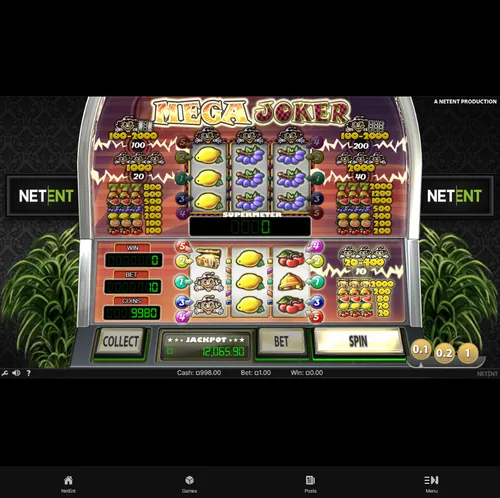
The game utilizes a simple three-reel layout with five paylines, focusing on classic fruit-machine symbols rather than complex bonus rounds or scatter symbols. A Mystery reward feature can trigger randomly during the base game, adding an element of unpredictability without altering the core mathematical model established by NetEnt in 2008. This simplicity ensures that the variance remains consistent across all standard spins regardless of the bet size chosen by the user.
Unlike Gonzo's Quest which offers a 2,500x max win through cascading reels, Mega Joker caps its maximum win at 200x due to its very high volatility structure. The absence of free spins means players must rely on the Supermeter mode to raise multipliers, requiring disciplined bankroll management to sustain long-term engagement. This design choice prioritizes steady returns over the occasional large payout found in more volatile contemporary titles from other providers.
Free spins round
Mega Joker does not include a traditional free spins round because the developer chose to focus on the Supermeter mode instead of granting bonus play credits. This decision aligns with the 2008 release date when many classic slots avoided complex bonus mechanics in favor of straightforward gambling elements like double-or-nothing wagers. Consequently, the gameplay loop remains centered on the base game spin rather than transitioning into a separate bonus phase with special modifiers.
The lack of free spins is evident when comparing Mega Joker to Gonzo's Quest, which utilizes avalanche mechanics to create potential chains of wins without requiring additional bets. While Gonzo's Quest features medium-high volatility and a 95.97% RTP, Mega Joker maintains a much higher 99.00% RTP but compensates with lower maximum win potential. This trade-off appeals to players seeking better long-term odds rather than the excitement of multi-hit bonus sequences found in newer releases.
Players expecting a free spins feature might find the single progressive jackpot trigger disappointing, as it replaces the usual bonus round attraction seen in other NetEnt titles. The randomly triggered progressive jackpot adds value without deviating from the core mechanic, ensuring that every spin retains equal importance in the overall return calculation. This approach maintains the integrity of the 1.00% house edge while providing a unique alternative to standard bonus-driven slot designs.
Trigger conditions
The Supermeter mode activates when a winning combination appears on any of the five paylines, prompting the player to decide whether to gamble the prize for a higher multiplier. This trigger condition is fundamental to the game's design, as it directly influences the effective RTP by allowing players to potentially increase their winnings beyond the initial payout. The decision to enter Supermeter mode must be made immediately after each win, adding a layer of strategic interaction absent in passive slot games.
A randomly triggered progressive jackpot can occur at any time during gameplay, independent of the payline matches or Supermeter activations that drive the main game flow. This event bypasses the standard betting limits and pays out based on the total wagered amount across the network, offering a chance for significant returns despite the 200x cap. The randomness ensures that even non-winning spins contribute indirectly to the jackpot pool, maintaining engagement throughout extended gaming sessions.
Mystery rewards trigger sporadically during the base game, providing small instant wins that do not affect the overall volatility or the 99.00% theoretical return percentage. These awards are distinct from the Supermeter gamble and serve as minor incentives to keep players engaged during periods of low hit frequency. Understanding these varied triggers helps manage expectations regarding win frequency and the distribution of payouts across different game modes.
Retriggers and extensions
Since Mega Joker lacks free spins, there are no retiggers or extensions of bonus rounds to consider within the standard gameplay framework provided by NetEnt. The concept of extending a bonus phase simply does not apply to this title, which relies on the continuous cycle of base game spins and Supermeter decisions. This structural simplicity eliminates the need for tracking bonus counts or remaining spins, focusing attention entirely on the current bet and potential outcomes.
The progressive jackpot does not extend or retrigger in a conventional sense, as it is a standalone event that pays out once per activation regardless of previous jackpots won. This mechanism ensures that the jackpot pool grows steadily until hit, without the complexity of multi-stage bonuses or cumulative triggers found in more elaborate slot machines. Players should view each jackpot opportunity as an independent event with fixed odds tied to the total wagered amount across the network.
In contrast to Gonzo's Quest, where consecutive avalanches can effectively extend a single bonus sequence, Mega Joker offers no such mechanical extensions or multiplier carry-overs between spins. The 200x maximum win limit applies strictly to individual wins, preventing any compounding effects that might artificially inflate the payout potential beyond the stated cap. This rigid structure reinforces the high volatility nature of the game, ensuring that large wins remain rare and isolated events.
Multiplier mechanics
The Supermeter mode serves as the primary multiplier mechanism, allowing players to double their winnings repeatedly until they lose the gamble or choose to cash out. Each successful gamble increases the multiplier, potentially turning a small win into a substantial payout within the context of the 200x maximum win limit. This mechanic requires careful risk assessment, as each step carries a 50/50 chance of success, directly impacting the short-term variance experienced by the player.
Unlike Gonzo's Quest, which uses increasing multipliers during consecutive avalanches to boost payouts up to its 2,500x cap, Mega Joker's multipliers are limited by the Supermeter's binary outcome structure. The 99.00% RTP is achieved through this high-risk, high-reward system, where the house edge of 1.00% is mitigated by the potential for compounded wins. Players must balance the desire for higher multipliers against the statistical probability of losing their accumulated stake during the gamble phase.
The multiplier mechanics do not interact with the randomly triggered progressive jackpot, which operates independently of the Supermeter and base game wins. This separation ensures that the jackpot contribution remains unaffected by the player's multiplier choices, maintaining the integrity of the network-wide prize pool. Understanding this distinction helps players appreciate how different features coexist within the game's mathematical model without overlapping or interfering with each other.
Mega Joker: key facts
| Parameter | Value |
|---|---|
| Game | Mega Joker |
| Studio | NetEnt |
| Released | 2008 |
| RTP | 99.00% |
| House edge | 1.00% |
| Volatility | very high |
| Max win | 200x |
| Reels | 3 |
| Paylines / ways | 5 |
Bonus buy option
Mega Joker, developed by NetEnt in 2008, does not offer a bonus buy feature for its progressive jackpot or Supermeter mode. The game relies on randomly triggered events rather than upfront purchases to activate high-value modes. This structural choice prevents players from paying directly for the chance at the 200x maximum win cap available in the base game.
The absence of a purchase mechanism means players must engage with the standard 5 paylines and 3-reel layout to progress through gameplay cycles. NetEnt designed this slot to function without optional side bets that grant immediate access to special features or enhanced multipliers. Consequently, the return to player percentage remains tied strictly to voluntary wagering decisions made during active sessions.
This design philosophy aligns with classic fruit-machine traditions where luck dictates progression rather than financial transactions for features. Players cannot bypass the volatility associated with the 99.00% theoretical RTP by buying specific outcomes or triggers within the software architecture. The focus remains entirely on the core spinning mechanics and the potential for mystery rewards during regular play.
Cost of buying the feature
Since Mega Joker lacks a direct purchase button for its Supermeter mode, there is no fixed monetary cost to enter the double-or-nothing gamble. Players instead incur costs through their mandatory bet levels on the 5 paylines while attempting to trigger the random progressive jackpot. This indirect pricing model requires continuous engagement with the base game to accumulate chances for higher multiplier states.
The lowest bet level activates an RTP configuration of 76.90%, which significantly impacts the effective cost per spin compared to higher stakes. Engaging with the Supermeter mode involves risking existing credits to raise the multiplier, creating a variable cost structure dependent on previous wins. This contrasts sharply with games like Divine Fortune, where specific feature triggers might have different economic implications for the player.
Without a defined price tag for feature entry, the financial burden is distributed across every spin placed on the 3-reel interface. NetEnt ensures that the house edge of 1.00% applies uniformly regardless of whether the player is in base game or Supermeter mode. This uniformity eliminates any premium surcharge for accessing the more volatile segments of the slot's payout table.
The lack of a buy feature means players cannot budget specifically for feature activation, making bankroll management reliant on overall session variance. Every spin carries equal weight in terms of potential progression toward the 200x maximum win, without additional fees attached to special modes. This approach maintains transparency in how the theoretical return is calculated over long-term play.
Is the feature buy worth it
Evaluating the worth of a non-existent bonus buy requires comparing Mega Joker against titles like Divine Fortune, which offers medium volatility and a 96.59% RTP. Without a purchase option, players avoid the typical premium paid for instant feature access, keeping the effective house edge closer to the stated 1.00%. This preserves capital for extended play rather than spending it on guaranteed but often low-return feature triggers found elsewhere.
The 99.00% theoretical RTP suggests that skipping feature purchases allows for longer engagement with the same bankroll compared to slots with lower returns. While Divine Fortune provides a 1000x max win, Mega Joker’s 200x cap is achieved through consistent betting rather than expensive shortcuts. This makes the value proposition dependent on patience and strategy rather than willingness to pay extra for randomness.
Players seeking high-frequency payouts might find the absence of a buy feature less appealing than games offering predictable feature triggers. However, the very high volatility of Mega Joker means that occasional large wins can offset the slower progression caused by avoiding costly side bets. The net effect is a more sustainable gaming experience for those managing limited funds over many hours.
Base game versus bonus returns
Mega Joker presents a stark contrast between its base game RTP of 76.90% at the lowest bet level and its overall theoretical return of 99.00%. This discrepancy highlights the importance of entering the Supermeter mode, where the effective return increases significantly due to the double-or-nothing mechanic. Players relying solely on the base game face a much higher house edge than those who successfully trigger the bonus features.
The transition from base game to Supermeter mode represents a critical shift in expected value, moving from a 23.10% house edge to a mere 1.00%. This improvement is achieved through the randomly triggered progressive jackpot and mystery rewards, which do not require additional bets beyond the initial spin cost. Such mechanics incentivize continued play to reach the more favorable return conditions inherent in the bonus rounds.
Comparing this to Divine Fortune, which maintains a steady 96.59% RTP throughout, Mega Joker offers a dynamic return profile based on mode switching. The 5 payline structure in the base game provides frequent small wins, but the true value lies in accessing the Supermeter’s enhanced multiplier potential. This dual-layered return system requires strategic attention to when and how often the bonus modes are activated.
Feature frequency in practice
NetEnt designed Mega Joker with randomly triggered events, meaning feature frequency depends entirely on chance rather than fixed cycle patterns. The Supermeter mode and progressive jackpot appear unpredictably, requiring players to endure the high volatility characteristic of the slot. This randomness ensures that no two sessions yield identical feature distributions, unlike games with scheduled bonus triggers or guaranteed cycles.
The 99.00% theoretical RTP implies that over hundreds of thousands of spins, the frequency of winning combinations balances out to this return rate. However, the very high volatility means short-term sessions may see long stretches without significant features, testing player patience and bankroll resilience. This statistical reality distinguishes Mega Joker from lower volatility titles that offer more consistent but smaller payouts over similar timeframes.
Unlike Divine Fortune, which may have more predictable feature activations due to its medium volatility setting, Mega Joker demands acceptance of irregular reward intervals. The 3-reel, 5-payline layout contributes to this unpredictability by limiting the complexity of winning combinations in the base game. Players must therefore rely on the cumulative effect of many spins to realize the advertised 99.00% return over time.
Special mechanics of this title
Mega Joker by NetEnt operates with a 3x5 reel layout and 5 paylines, establishing its classic fruit-machine structure for players seeking traditional slot mechanics. The theoretical RTP reaches 99.00%, meaning the house edge sits at just 1.00% over extended play sessions compared to standard slots. This high return rate suggests that disciplined bankroll management is essential to withstand the inherent variance of the game during long-term engagement.
The volatility rating is very high, which directly impacts the frequency of payouts and requires patience from those playing the Supermeter mode. Unlike Dead or Alive by NetEnt which offers 8,600x max win potential, Mega Joker caps its maximum win at only 200x despite its superior RTP percentage. Players must accept lower top-tier rewards in exchange for the significantly better mathematical expectation provided by the 99.00% return configuration available online.
No free spins feature exists within this title, so the Mystery reward and randomly triggered progressive jackpot serve as the primary sources of extra value. The absence of complex bonus rounds keeps the gameplay straightforward, focusing attention on the core spinning mechanics rather than elaborate thematic sequences. This simplicity ensures that every spin contributes directly to the statistical outcome without distraction from secondary game elements or side quests.
How the studio built the maths
NetEnt designed Mega Joker with a dual-RTP system where the 76.90% configuration applies at the lowest bet level outside the Supermeter mode. Switching to the Supermeter mode unlocks the full 99.00% theoretical return, creating a strategic decision point for every single wager placed by the player. This mechanic forces users to actively choose between higher immediate risk and long-term mathematical advantage through deliberate betting adjustments.
The house edge of 1.00% represents one of the most favorable conditions in online casino gaming when the optimal mode is activated. In contrast, other titles like Dead or Alive maintain a much higher house edge due to their 96.82% RTP and high volatility profile. This significant difference highlights how NetEnt engineered specific rules to reward skilled play while maintaining a sustainable margin for the operator over time.
Calculating expected loss involves multiplying the total turnover by the 1.00% house edge, providing a clear metric for budget management during extended sessions. For instance, spending 100 € results in an expected loss of exactly 1.00 €, demonstrating the mathematical efficiency of the 99.00% RTP configuration. This transparency allows players to make informed decisions about their bankroll allocation without relying on luck or subjective intuition alone.
Feature variants and levels
The Supermeter mode functions as a double-or-nothing gamble mechanism that raises the multiplier for subsequent wins within the same session cycle. Players can collect winnings from base game hits to fund this higher-stakes environment, effectively doubling their potential payout if they succeed repeatedly. This feature demands careful risk assessment since losing the gamble returns the stake to the base game without any additional multiplier benefits.
Mystery rewards trigger randomly during gameplay, offering instant cash prizes that bypass the normal payline evaluation process entirely. These unpredictable bonuses add an element of surprise to the otherwise structured 3x5 grid layout, keeping engagement levels high throughout extended play periods. The random nature ensures that no two sessions follow identical patterns, maintaining interest despite the static visual presentation of the classic fruit symbols.
Progressive jackpots activate randomly, separate from the Supermeter mode, providing another avenue for substantial wins beyond the standard 200x maximum cap. This feature operates independently of the player's actions, meaning it cannot be triggered by strategy but only by chance during regular spinning. Understanding this distinction helps manage expectations regarding win frequency and potential payout sizes across different gaming sessions.
What the bonus can pay
The maximum win of 200x applies to the highest possible stake multiplied by the winning combination on any given payline during standard play. This cap limits the potential upside compared to high-variance slots like Dead or Alive, which offers an 8,600x maximum win potential for risk-tolerant players. Consequently, Mega Joker suits conservative bankrolls better, prioritizing consistency over the rare chance of life-changing large payouts during a session.
Bonus terms often include a 300% welcome bonus up to €2,000 plus 100 free spins, which may affect how players approach the 99.00% RTP. However, these promotional funds usually carry wagering requirements that alter the effective house edge until the bonus money is fully converted into withdrawable cash. Players must calculate the true cost of these promotions against the theoretical return to determine if the bonus adds genuine value to their overall strategy.
Free spins are included in the welcome offer but do not apply to Mega Joker itself, as the game lacks a free spins feature entirely. This mismatch means promotional spins might be allocated to other NetEnt titles instead, requiring players to select games carefully to maximize their bonus utility. Understanding this limitation prevents wasted effort trying to use non-applicable bonuses on slots that fundamentally operate without such mechanisms.
What the feature costs in practice
Participating in the Supermeter mode requires depositing collected base game winnings into a separate meter, effectively increasing the stake size for each subsequent spin. This action raises the potential payout but also increases the absolute amount lost per hour due to the fixed 1.00% house edge applied to a larger total wagered sum. Players must weigh the higher variance against the improved RTP to decide if the increased risk aligns with their personal financial goals.
The 76.90% RTP configuration at the lowest bet level outside Supermeter mode presents a significantly higher house edge of approximately 23.10%. This steep disadvantage makes playing without entering the Supermeter mode mathematically inefficient, as the expected loss per unit wagered triples compared to the optimal 99.00% setting. Strategic players avoid this trap by consistently funding the Supermeter whenever possible to maintain the favorable long-term return rate.
Time spent playing affects the total cost due to the speed of spins and the resulting volume of wagers placed against the house edge. A faster playstyle increases hourly turnover, thereby accelerating the realization of the 1.00% expected loss even with the best RTP configuration. Managing spin speed and session length remains crucial for controlling overall expenditure while maximizing the benefit of the game's mathematical advantages.
DemoRTP & VolatilitySymbols & PayoutsBonus FeaturesStrategyBonusesMobileDownload & AppMax WinSimilar GamesReviewFAQSitemap
Mega Joker 2026